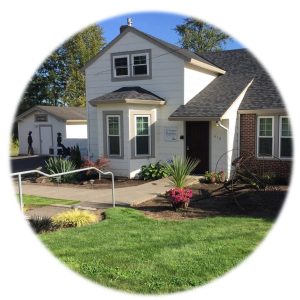
Suzi – Good morning. I am Suzi Terrell with the La Center Historical Museum. Today is October 19th, 2023. I am here in this beautiful home with Roberta Emerick, and she is going to tell us a little bit about her life growing up in La Center. I’d kind of like to maybe start with a little bit of history of your grandpa Pollock coming to town.
And Roberta, I want you to feel free to talk about whatever and how much you want to bring in. I am very interested in your time growing up in La Center and your time at the roller rink – that seems really fun to me, but this is your interview so we can do whatever you want.
Roberta – You’re very gracious. Thank you for coming. Yes, I am enjoying my new home. I just moved in about April, I believe. It’s been very comfortable for me.
Well … La Center. When you asked the questions earlier, I did a sheet to try to get kind of acclimated to what you were going to ask me. I figured that I lived in La Center for 15 years, from 1941 to 1956. In fact, I had my fifth birthday party upstairs in the old hotel lobby. My mother had invited all the town kids so we could get acquainted. Somehow, she had a friendship with Naomi Sheldon. Her husband was Amos who had the garage in La Center. She had a son, Tommy, and she had other kids, but Tommy was my age and in my grade when we went to school.
We were known as the town kids and there were several of us. There was Ray Soehl and Shirley Riegel (now Shirley Thayer), and she was one of my best friends growing up. We were in the same grade throughout school. I graduated in 1954 from La Center High School.
Suzi – So you went pretty much all the way through school?
Roberta – Definitely. We didn’t have kindergarten so we started out in first grade and I had a wonderful first grade teacher. Her name was Leah Bourgeois and I think we all remembered her because she just got us on the right foot all the way around. I don’t know whether she’s the one who inspired me to go on to be a teacher or not, but when I think back at my teachers, I always had a good experience in school.
Suzi – That’s good because the teacher can kind of make or break you.
Roberta – Well … yeah. I can remember one teacher. I think it was in sixth grade. Someone had misbehaved in the class – and he, liked to use that little swatter. But he didn’t do it just to the person that committed whatever, he did it to the whole class! So we were all embarrassed.
Suzi – Oh my!
Roberta – He was a coach and that was his thing. Yeah, that’s the only time when you asked, did you ever get in trouble? That’s about it … I don’t think I did!
Suzi – And you didn’t but you still got punished!!
Roberta – Yeah, that was kind of interesting. Times have changed.
You asked where my family was from. My mother was born in La Center in 1905. My dad was born in Lansing, Michigan in 1897. His family came West to work in the woods and find work in Seattle and so forth. He had three sisters and one brother, and they were not too far away. But, my mother was an only child. She lost her sister, Dorothy, early on when they lived in Centralia, so – I’m an only child also.
Suzi – Oh, wow. Now that’s kind of unusual for back then because it was like they had pretty good-sized families to work the farm and help out.
Roberta – Yeah, well in some ways, it was good that I became very independent. My great-grandfather married Eliza Banzer. Well, there’s quite a story in the museum about John Pollock. I was so glad that Tom Wooldridge worked to get that park named after my great-grandfather. His son, James, married Laura Smith from Yacolt, and that’s where my mother’s family was from. Later on of course, they were in La Center and then moved to Centralia. But I thought that was interesting because now I live close to Amboy and Yacolt.
Suzi – How old were you when your parents bought the skating rink?
Roberta – That’s a good question – probably in the early 40s, about maybe ‘42 or ‘43. I’d have to research that to make sure, but I’ve got all the records and things from the skating rink which are very interesting. But, I’m in the process of sorting. When you move from one place to another not everything’s in order. But yeah, the skating rink was the highlight of my life, of course being an only child – that was special.
Suzi – So when you first moved in, was the rink intact or did they build it? It just seems like that would be an exciting thing for you as a little one at five or six years old.
Roberta – Well, when I first saw the old dance hall as they called it, it was all attached. It was the hotel confectionary – well, it was a restaurant and then there were two other little niches in that attached building. One was a barber or beauty shop. Anyway, my first view was that the entire floor was warped and just an unusual sight for me to see. It wasn’t a natural floor at all, but all the maple flooring for the dance hall had warped and so the building really was unusable for anything for quite some time. But then in the early 40’s after … see, dad worked in the shipyards when they first moved in there. He fixed up some of the rooms upstairs for hotel purposes and mom ran the cafeteria downstairs. They had this cook and mom baked the pies and all that stuff. So that’s when old 99 was going through. That was kind of a busy time.
At any rate, as things evolved, they built the new highway I-5 and bypassed La Center and so forth, but yeah, it’s hard to get your thoughts together on that when you were so young to help with this interview. At any rate – it was a good time. Well, dad figured they should do something with that building and they were able to come across a sale on roller skating equipment, which included the music, the amplifier, the whole works with all the skates and so forth. So dad transformed the old beauty shop corner of that building into a skate room. There was a stage at the end of the hall that we used to like to play on. That was there for several years until dad tore it out and expanded the footage out further, so it made a ‘40 by ‘90 skating area. What’s interesting is when they laid the floor. They laid it flat and then across so that it would go with the grain of the skating because maintaining a floor for skating has to be tricky. Lots of people fell down and put dents in it. But anyway, dad was very good at cleaning the floor after every session and cleaning the skates and they looked tip-top and ready to roll. Sometimes when you have roller skate wheels with ball bearings in them, they would break. I remember one time the ball bearings went everywhere! Dad’s famous saying was “clear the floor!”
Suzi – About how many kids could be out there at one time?
Roberta – Oh gosh, you know, it was who knows, 20 – 30. It was pretty crowded sometimes, but everybody worked at skating. I was fortunate to have what they call precision skates. They had wooden wheels with ball bearings that were encased somehow so I didn’t have the free rolling. I could never master that fancy skating. That wasn’t me. Dad had to sit me down several times on the bench for playing roller tag. Not a good thing, but I could never master the fancy stuff.
Suzi – And is that where you met Frank?
Roberta – No, he was a Green Mountain boy who came to school in La Center. He had his choice of Battle Ground or La Center or Woodland and at that time, the Green Mountain boys were coming down there, and they had a good sports program, too. But he was just kind of short and stocky and I didn’t pay too much attention to him until his Junior year, then they get this growth spurt and he looked pretty good. But it was one of those things that transpired, you know, over a period of time. That was a good time for all. Then I went on to college for two years before we got married, and he went to Clark College also. So that was kind of neat and then we got married August 16th in 1956. He was in the military, in the Air Force, and got stationed in Spokane where we had our two children, Leslie and Curtis. Then he got his orders to go to Guam. So there were nearly two years spent in Guam.
Suzi – And you went, the whole family went? Oh, that’s terrific!
Roberta – So that was an experience, and all military families know what that experience is about. You come home pretty broke and so we moved onto the place we’re on now. They had a little cabin for the grandparents, and we fixed that up and we lived in that for five years. But then he got on at the Forest Service and we just couldn’t make ends meet so we just stayed there. He put on another couple of additions and that’s where we stayed ‘till he passed away in June of last year (2022).
Suzi – Well, it’s beautiful property. I can see wanting to stay here.
Roberta – Well, this is the place where he was born – not too far from the front door. He knew what the sunsets were like here so we fashioned the house so you get a full view of them and that’s something I’ve been enjoying since I’ve been here. Yeah, my granddaughter pastures horses down below so it’s just an all-encompassing joy to live here.
Suzi – Now I read somewhere that you and Frank like to square dance.
Roberta – Oh that was fun. It was a good time, ten years of it. They cleaned up the old log cabin on Chelatchie Prairie and we had the Timber Toppers Square Dance Club and our kids became Teen Toppers. It was a good family entertainment for many years. We made many friends. Some of our longest-lasting friends were from square dancing.
Suzi – How did you get involved with the La Center Museum? Did you know Margaret Colf, you know before your time at the museum, or did she seek you out or were you a friend of a friend who just got snagged because that’s kind of the way I got into it!
Roberta – No. Margaret used to stop in at the skating rink. She was very active at the school and she and my mother struck up a friendship. I remember her coming in and I had made a candy house for Christmas. It took her eye. She says, “I want to borrow that”, and she took it up to school to show off. I was just a young girl, so I knew Margaret and Margaret knew Frank since he was born.
Suzi – Oh, I’ll be darned.
Roberta – She’s a Green Mountain gal too. We got involved, not so much with the La Center Museum, but of course with the Amboy, North Clark Historical Museum in 1988. So we spent a good 25 years before we retired from the museum in 2013. But we still are active even today in various things, you know, on call or doing their archival scrapbook. So that was a special time and now that La Center has developed their museum, I’m anxious to get some of the history that I have about La Center and the skating rink and so forth down there.
Suzi – Yes, and we thoroughly love it. The display that we have now Is quite popular when the school kids come through to tour. They can’t imagine going and doing that and having a place to really hang out like that. Kids need that kind of spot.
Roberta – Yes I think so. No, those were special days. I remember mom and dad, when they would close, they allowed a half-an-hour after for a sock-hop and the kids would bring their own music. That was after I left. I was only there until I got married, and then the folks carried on. I talked to some people that helped them with the rink and I thought, WOW, you know, they had a whole life, but I had a separate life too. But my kids were old enough to get skates on, well Leslie was and Curtis was rolled around in a stroller.
Suzi – Oh, I’ll be darned.
Roberta – So, you know it evolved. Then later on I went to a skating rink up in Olympia and they were all using in-line skates. I thought that was so unusual. So we graduated from the four wheels which you felt secure with, on to in-lines.
Suzi – Oh, so you did get on those?
Roberta – No! I wasn’t that good. I’m the observer when it comes to skating. Oh well, that’s fun.
Suzi – Were you still in the area when the hot air balloon guy moved into at least part of that complex where the skating rink was?
Roberta – Oh that sounded interesting. I never went down and looked at it. But another couple had bought the skating rink when my folks decided to give it up, you might say, when their health deteriorated, so they found a place in in Vancouver to move.
And, I think I’ll share this with you. When dad came down to La Center, my mother of course being born there, said she’d like to get back to La Center. So he came down and found this dance hall and so forth in disrepair. The cost at the time was $3,000.
Suzi – Wow, okay but that was still a big deal! Right?
Roberta – It was! Evidently there was about an acre there. Anyway, I have mom’s checkbook where she made monthly payments to pay it off because you know, nobody had big money in those days. But at any rate when they finally decided to sell, they sold it for $30,000! Just for the books to know, I thought and they thought that was, a big deal. But then they bought a house in Vancouver with that money, and they lived a very comfortable life. It was quite amazing to me in today’s time, that’s for sure.
I don’t know how anybody could buy anything anymore. But we saved for this place and I’m so glad that we were able to make good investments, even though I was on a teachers pay and he was with the forest service, we made it just fine.
Suzi – So tell me about you being a teacher. Where did you first start?
Roberta – Well, of course, I started substituting at Great Mountain School and it was fun for me. I just enjoyed it. Previously I had a job at the school as a teacher’s aide and that kind of got me wound up. I said … well, why don’t I just go ahead and get my degree? I’ve got two years of college behind me and it wasn’t too bad. My kids by then were in like seventh and eighth grade. They’re only 13 months apart so it was – you know – they were buddies and a lot of things with them was special. Their relationship even now is special. Then a job came up in Amboy. So from that point on, for eight years I taught in Amboy, and then they realigned the schools, and I went to Yacolt and I spent 12 years there, so 20 years in total.
Suzi – Did you stay in the same grade?
Roberta – Second Grade one year and Third, the next year, then the rest in Second Grade. It was a delightful experience. They still loved their teacher.
Suzi – Yes. I was gonna say something not politically correct, but that they’re still little human beings at that point and adorable. I just don’t know how teachers with the older kids can handle things, especially now things are kind of crazy.
Roberta – Seems like there’s all kinds of temptations out there, but when you stop and look at your own family, they do okay. Yeah, they all survive. They grow up to become very nice people.
Suzi – Wonders, right? So for the most part then it was enjoyable?
Roberta – Oh yeah. But since I was an art major the kids got a good dose of art but I always considered writing an art, so they had to do their penmanship very well for me.
Suzi – Yeah, and that’s something they don’t even teach anymore.
Roberta – Well, I don’t know, I’ve got great grandchildren now and they seem to be coming along good. They both go to Green Mountain School, which Frank went to and actually, his mother and father went to Green Mountain School also. So they’re carrying on in the tradition and another note of interest is that Doctor Hoffman in Woodland, delivered Claude, Frank’s father, and he delivered Frank too. Yeah he was pretty rooted in this area.
I was born in Bremerton, Washington and my folks first didn’t move down ‘till the early 40’s. There were similarities because Frank’s father worked in the shipyards too. And so, everybody basically was helping with the war effort.
Suzi – Well back to La Center … you would have been pretty young I believe when our midwife Mettie Sheldon was delivering babies. But she was in town for quite a long time and ran the gas station, so were you aware of her? Did you know her?
Roberta – I can remember the house she lived in and I must have seen her around because various people were delivered by Mettie. I certainly knew of her, but my life was pretty much centered at the hotel. My Aunt Martha lived across the bridge in a little house. Tom Wooldridge built on the property. There used to be another house below his where I would walk across the bridge and visit her. She was a stepsister of my mother’s father, James.
Suzi – Now I remember hearing tell of stories where kids would walk from up in the View area down across the bridge to Woodland to go to a movie, and then back in the same night. And I try to relate that to nowadays kids and I just can’t imagine number one, the parents allowing all these kids to do that, but that didn’t sound like something that you had gotten involved with.
Roberta – Well, no. My track was to school every day. It was from home to probably close to a mile. My friend Shirley was up on the hill so she had a little further to walk than I did. But the bus would come down the hill, where there used to be a triangle out in front where the skating rink was – just a big deep trench or creek running through it and another road ran up to La Center. So it was like a triangle, and that bus would go down the road and go across the bridge and pick up the kids on the other side, but they never picked up the town kids. I always had a grievance about that because when we’d get to school, I remember my mother making me wear these long stockings and they were soaking wet and my teacher would lay them on the heat register. There was some fun stuff going on those days, but yeah, I walked to school along with the other kids for years.
Suzi – Yeah, that’s different that the bus wouldn’t even stop to pick you up.
Roberta – Well that just wasn’t in their planning. Yeah, there were a lot of kids in town and it wasn’t that big of a walk, but we walked on the wooden plank sidewalks the first few years I went to school until they deteriorated. Then you had to walk on the side of the road.
My dad used to take a bucket and go across the road when we first moved there to pick up horseshoes. He’d come in with a big bucketful because there was a livery stable across there at one time. So I learned playing horseshoes pretty good. And then I remember, talking about my father, he went down on the riverbank and he would collect clay. There was a gray clay down there. He’d bring it back in buckets and I would make all kinds of goodies. I’ve still got one of those little clay pots around here. So there were things you did, you know, it was kind of fun in La Center.
Suzi – I heard that somebody had made a very minor type of a water park right down where the bridge is now in that area where they had three different slides that kids would climb up a pole on and then slide down. They also had these little cabanas set up on poles that you could go up to change your clothes and that it was quite popular even up through like Tacoma, people would come down. And I have yet to see pictures of that. I’m always hoping that someone has some in their shoeboxes full of old snapshots so I’m hoping that they’ll run across something like that sometime.
Roberta – I’ll just say if you look at the old pictures I could see that happening, because the river was pretty and they had some beaches. There were some people that lived down the river that had lovely homes. Friends would walk down then go swimming. I was never a good swimmer, but always went down and enjoyed you know everybody. But yeah, that was a great swimming hole. I imagine it was down there in that area.
Suzi – I think it was Bill Barnhart who was interviewed in the article I read.
Roberta – Oh yeah, Bill would’ve been a good resource for you.
Suzi – So do you have any funny or maybe even scary stories that you remember that happened in and around town?
Roberta – Probably lots of funny ones but no real scary ones that I can think of. I remember when the big fire was up in the hills and you could see the smoke. It came right through La Center. I remember that. There were a lot of tragic things going on at that time and I’m not just sure what year that was but it had to be in the 40’s because I was there right. I’ve had kind of a fear of forest fires of course and we’ve had some close calls here lately. I think it was last year. That was something to think about, that would be the scary things – the weather.
Suzi – Things like the Columbus Day storm?
Roberta – That was a good one, wasn’t it? Yeah, I was in the old house with the two kids and Frank was up in the hills working with the forest service when the storm hit and he had to retreat to a clear cut. They could hear crashing and everything all around them and when the wind subsided, they had to come out on what they called a toadgoat. They were little machines, you know, with wheels like a motorcycle that they’d lift up and over the logs. Finally they got out, but they didn’t get out ‘till late. I remember Frank’s father coming over and I was sitting in the living room and the roof was squeaking because the nails were being pulled out from the wind. It was frightening and I saw one tree by the corner of the house take off like an umbrella across the field. Anyway, he put a kid under each arm, and we headed for his house – and it wasn’t much better! His roof squeaked the same way. It subsided and Dad finally got home but boy, that was one of probably the most terrific storm I’ve ever been in.
We were in a storm in Guam where we had to evacuate to Nimitz Hill, to concrete bunker type things while the palm trees swayed. Our quonset hut that we were living in was tied down with cables and big blocks so we had a house to come back to, even though the wind and rain had come through it because there’s no windows – just screens. It didn’t really bother the house any. We did have to evacuate and that was a big deal. So, the weather is kind of a thing for me.
Suzi – Oh Definitely and you are surrounded by a gorgeous forest out there.
Roberta – Well, yeah. I’ve seen those trees flattened out sideways with the wind close to the creek. It seems like a natural trough down through there. I’m expecting some interesting weather as we go through life.
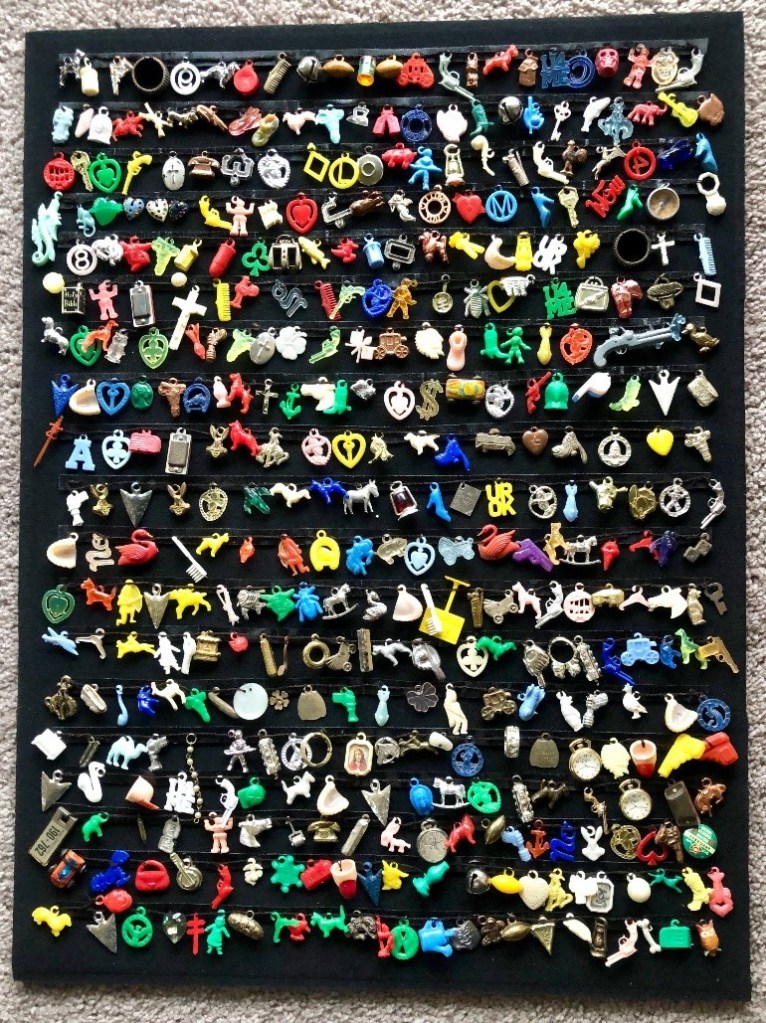
Suzi – I want to bring something around to have you maybe explain a little bit about this. It’s really nice! Very unusual. So what are these little figurines and trinkets?
Roberta – Yes, they’re great. Well, my mother started crocheting a chain to put these Items on from the bubblegum machine that was in the skating rink confectionary. She started early on and she attached them to the shelves where they sold the candy. When the kids would get something of interest, but they didn’t want to keep them, they’d give them to her and pretty soon this started to grow and grow. I suspect it’s close to 23 years accumulation there because kids really enjoyed seeing the chain grow. But they also enjoy seeing their little trinkets up there, so they bring in their own little things to put on. That was kind of sweet. My son even remembered that and he was pretty young, so glad to give it to the museum.
Suzi – Well, we’re really excited to be able to show it off and have the story to tell about it. There’s so many different variations here – it looks like little harmonicas and horses …
Roberta – I had fun playing ‘I Spy’ with my great-grandkids and they enjoyed it. So you’ll have to count them. I don’t know how many are on there. So that’s your chore!
Suzi – Maybe that will be a contest.
Roberta – I think you need to follow that.
Suzi – That would be fun and we thoroughly appreciate you donating this. Well, thank you.
If you can think of more things that we can chat about, you know, I’m at your disposal here. I think I’ve gotten most of my questions asked.
Roberta – Oh by the way, I have a copy of the Gola picture of La Center that he did in watercolors on display in the bedroom. Tom Wooldridge made me a copy and oh, I cherish it. Yeah, my great-grandfather’s house is in the corner.
Suzi – Very nice! Well one thing I wanted to ask you about and I don’t have my timeline just perfect here … were you and Frank involved with the Amboy Museum back when they were doing the remodel and taking all the panels of wood down and redoing that?
Roberta – Oh, I think so!! (laughing) The whole concept of the museum started in 1988 and we didn’t open the doors until 2000. That’s kind of a shock to some people … that it took 12 years. But the building was in total disrepair.
Suzi – I don’t know this part of the history.
Roberta -Frank was the Building Chairman. I did the coordination and all the volunteers, everybody pitched in, in town even. I mean when we were working on it, people would stop their cars and jump out and come in asking, anything I can do? It was amazing. It was an amazing time in Amboy’s history and we have a video of it, I think I gave it to you.
Suzi – That’s great because it’s so hard to get people to volunteer these days. I wanted to ask what your secret was for being able to get the whole town involved.
Roberta –Well for me, there was one woman, Barbara Waggener, who spearheaded this, and she was adamant about having a museum. We looked at a lot of buildings, even the Tumtum Log Cabin, in Chelatchie for a possibility. Then, there was property where a family was living at the time. She negotiated to buy that old church and put up the money for it. The people said “We can’t move out because we don’t have any place else to go.” So, she found a house in Yacolt for them to move into.
Suzi – Oh Wow!
Roberta -She financed the whole thing and we carried the loan through her and got an interest free loan through the PUD. So we were surveying all kinds of ways to get money and that really helped a lot, and eventually, we were able to pay off the entire loan. It was really a good experience, but yeah, we bought into that early on.
Frank’s uncle had worked on the church roof, putting the roof on when it was a church. So we had a family tie-in there. He fell off and broke his leg, by the way!!
Suzi – Oh my!
Roberta – So I had kind of a fear of this happening there, but luckily, I don’t think anybody really had any serious injuries. We had the one incident where the insurance agent came by and he went on the back porch, which was in total disrepair, and he fell through the porch!!
Suzi – Oh, dear! How’d that work out?!
Roberta -So there were some incidents, but it was a joy to do that. We had both retired, he retired in 1991 and then I retired in 1993, so he actually was involved with the museum pretty much full-time after retirement. Then, when I retired, I jumped in because I wanted to help him, you know.
Suzi – How did you first accumulate things to put inside? Once the building was getting close to being ready, did people in the community have things that they wanted to donate?
Roberta -You know that’s interesting when you stop and think, because our building wasn’t used other than to have some garage sales in the basement and so forth, and we had a makeshift museum decor in there for awhile. When the serious stuff started, everything had to leave. We had the old organ that was given to us stored in someone’s house. We had an airplane hangar full of stuff that we had that were loose materials that needed to be stored. I think that’s when I had started the archiving project way early on and I had all that in my house. So I basically housed the paper materials there. Everybody pitched in and had something, you know to get out of the building, right? It was quite a core group in the beginning. What pleases me right now is that one of my former students is the president of the North Clark Museum now, so that’s rewarding for me to see her.
Suzi – Yeah, that’s great. I know with our La Center Museum Tom Wooldridge was such a major contributor, so without Tom it’s been a little here and a little there that come in. So it’s hard to get something new. I love to rearrange but it’s the same stuff that we just kind of move around to freshen things up. Every now and then we’ll get in enough items to make a real display.
We have a guy that I call a kid, and I shouldn’t do that. He’s like 28 years old but I think anybody as a kid if they’re under 30, who is interested in history and he especially likes to focuses on La Center items. That’s all he does. He does postcards and old cabinet photos and buttons and you know all kinds of things like that, but it’s all La Center. He pays a lot of money for these, you know at auction and stuff and so again anybody under 30 that is interested like that, I just dearly love because sometimes it’s hard to get anybody interested in the old stuff.
Roberta – So people come in and go and some of them pass on. I think when Margaret passed, that was one of the saddest times, because she did so much for museums and the whole business, she was vital. But, on the selfish side, the Emerick’s had so much stuff that we were able to donate a whale of a lot and get it out of our house and the barns and all. So, after a while people caught on like, oh, we can give it to the museum, and it’s worked out perfectly. We got some nice items in there right off-the-bat. We got things filled up pretty good.
Suzi – Well it’s a wonderful museum. I love going through and always wondered who did the little people, the stuffed people that are there. That was such a clever and unique thing to do and they fit right in.
Roberta – I love those too. Well, her name is Marie Downing. She used to be a Sutton and we used to put floats in all of the Amboy Territorial Day parades. There weren’t enough people like you say, you know, you’ve got only a core group to ride the float. I mean, you know, we just didn’t have them, so she decided to make some mannequins and we had those on the floats. Then as things moved on, they moved in! When we got the museum done, she had about six or seven mannequins, but we had used them to promote the museum in parades.
Suzi – Well what an idea! I know that the idea has come up a time or two of the museum having a float in the Our Day’s parade but again there’s not enough of us and those that are there, are also involved in like the Lion’s or other organizations, so they’re already marching in that. So the idea of a mannequin … see we have one mannequin that is our mascot. He was Ken Viles’, well actually it was his wife Myrna who donated her father’s World War I uniform. And Ken had bought a mannequin form for it to go on and they donated that to the museum. And after Veteran’s Day, I thought, well I don’t want to just put him away in a closet, so I got the bright idea to turn him into a lumberjack. So we had a ‘real’ lumberjack that outfitted him, including the spiked shoes.
Now this mannequin was not flexible at all, so getting those shoes on him was a real struggle. I wished that I had a video of us trying to dress him! He’s kind of front and center when you first walk in the museum, and he startles people. But they all recognize who Jack is now and we have taken them to different Our Day’s functions and stuff like that … but I never thought of putting them in a float.
Roberta – Oh that’s what’s fun! Get somebody with a little trailer and it’d work out fine. We have our lumberjack and it happens to be a replica of Marie’s husband, Kenny. She used his hat because he worked in the woods for years, so we’ve got his boots and we’ve got his hat and his shirt and his suspenders. Yeah, but he’s flexible – he sits in the chair.
Suzi – Yeah, see Jack doesn’t sit. He’d have to be standing the whole time but yeah, that’s a fun idea. I have to keep that one in mind.
Roberta – She is very talented. Many things she did for the museum along with other talented folks – it really adds a lot to the whole thing. We’ve been very fortunate, and I’m really tickled about what’s going on up there now because they’re carrying on with everything that we had started and worked for, so yeah, that’s a good thing.
Suzi – It is a very good thing! There are so many times that we get people that, you know, finally come through and we ask them is this your first time they said, yes. Then they mention they’ve lived in La Center for 30 or 40 years!! It’s like, okay!!! You know we try to get the word out with all the school groups but … you know there’s been times when we’ve had over 230 kids come through in one day.
Roberta – That’s a lot of kids.
Suzi – You know they’re staggered.
Roberta -We did that too.
Suzi – But you know, we love having them come through and they do get excited over the roller-skating rink display. It’s funny what strikes some of their interest and others – they could care less, but we like to get them young to get them interested in their history.
Roberta – I’m so glad you’re doing that. That’s a good step in the right direction to get them younger to appreciate history, what’s come before them. Yeah, I always felt good about that too.
Suzi – So you know the hope is that they will go home and tell mom and dad about it, sisters and brothers and they’ll want to come back and visit. So you know that’s what draws them in.
Well Roberta, if you don’t have anything more, we can always do this again and add too but it’s been a real pleasure for me to meet you and come out and get some of my questions answered and learn a whole bunch more that I didn’t know about.
Roberta – I didn’t even cover all my notes but I’m going to set those aside or we’d be here all day.
Suzi – Well it’s been a real pleasure and I thank you very much.
Roberta – You’re welcome.
 La Center Historical Museum